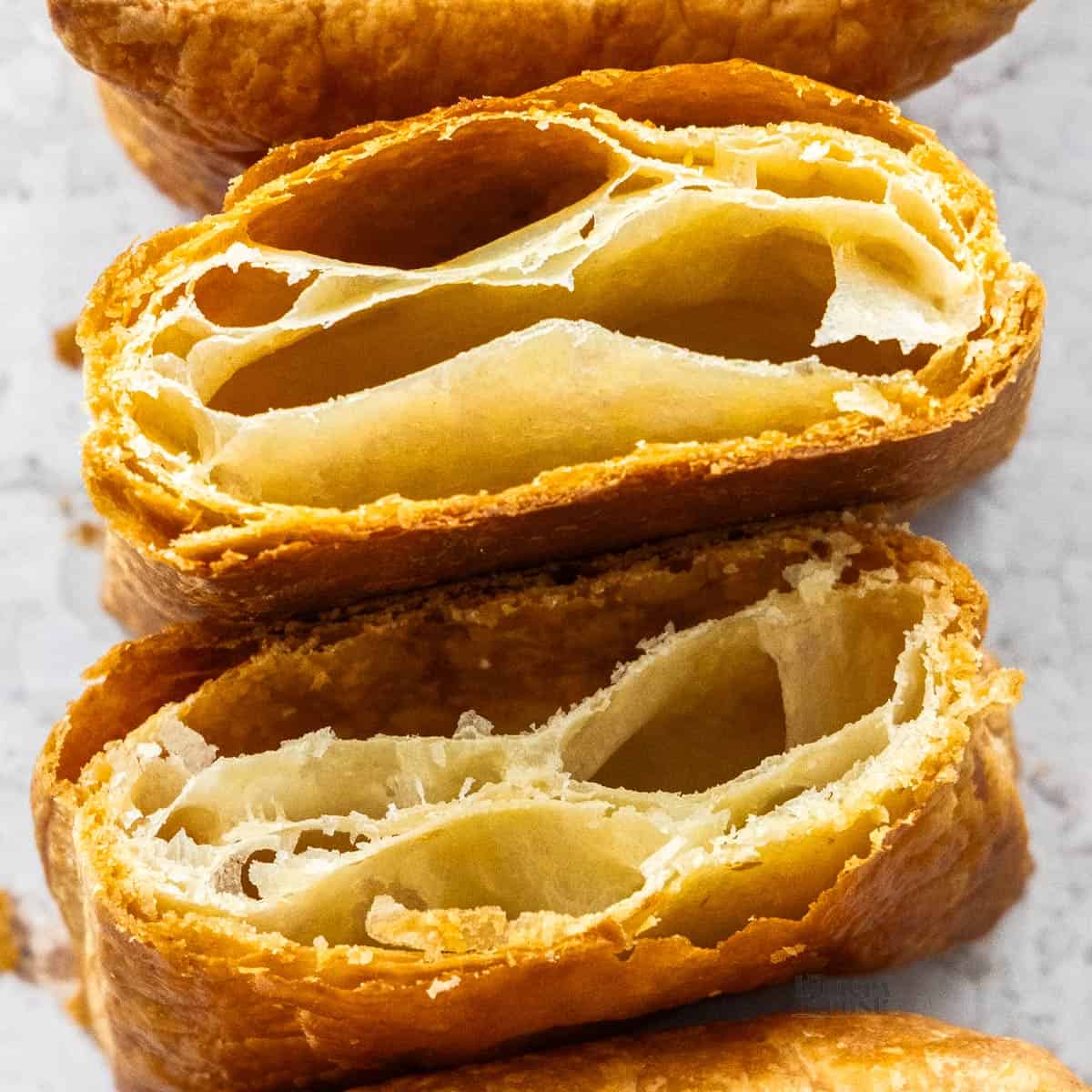
Rough Puff Pastry Recipe
Make rough puff pastry that's light, buttery and beautifully flaky, with an easier method that puffs almost as high as classic puff pastry.
Print
Pin
Servings: 10 serves
Calories: 243kcal
Equipment
- Large measuring bowl
- Rolling Pin
- Rolling pin guides useful but not necessary
For best results, weigh ingredients with a kitchen scale.
Ingredients
- 200 g unsalted butter cold - for butter block (7oz)
- 25 g unsalted butter (~1oz)
- 125 ml cold water (½ cup)
- 1 teaspoon white vinegar
- 225 g bread flour or all-purpose flour
- 5 g salt (scant teaspoon)
Instructions
- THE DOUGH:Grate the 200g of butter and chill until required.
- Grate the 25g of butter and set aside.
- In a small bowl, combine the water and vinegar. Set aside.
- In a medium or large mixing bowl, whisk together the flour and salt until well incorporated.
- Add the water & vinegar mixture and the melted butter (not the grated butter) and immediately stir with a spoon (don’t wait or the butter will begin to solidify in the cold water). When you’ve mixed as much in as you can with a spoon, use your hands until it just comes together into a ball of rough dough.Tip: Don’t overwork the dough at this stage.
- Slice a crosshatch design in the top of the dough, then wrap in plastic wrap and chill for 30 minutes.
- ENCASE THE BUTTER:Dust a clean work surface with just a little flour, then dust the top of the dough lightly.Tip: Only ever add flour if the dough is sticking to the work surface or the rolling pin.
- Roll the dough out to the same width as the butter block and twice as long - so roughly 15x30cm / 6x12in depending on how square you got the butter block.
- Scatter the grated butter evenly over just ⅔ of the dough, then press down lightly with your hands. Fold the bare end of dough over the centre, then fold the final third (topped with grated butter) over that and press down lightly.
- FIRST FOLD:Dust the worksurface and dough if needed.
- Turn the dough so the join points toward and away from you. Roll the dough out to about 5mm / ⅕ in, focusing on making it long rather than wide. It should not go beyond 18-20cm/7-8in wide.
- Use a pastry brush to brush away any excess flour from the top face of the dough.
- Fold the bottom third of the dough up over the middle third. Brush excess flour away. Then pull the top third of dough down over the centre as well, so now you have 3 layers when you look at the end of the dough.This is known as a single fold, simple fold or a letter fold.
- If the butter has significantly softened, chill the dough for 10-15 minutes before continuing.
- SECOND FOLD:Turn the dough so the join is pointing towards and away from you.
- Roll it out again to 5mm / ⅕ in focusing on making it long rather than wide and keep the sides as straight as possible by tapping them in as needed.
- Use a pastry brush to brush away any excess flour from the top face of the dough.
- Fold the bottom third of the dough up over the middle third. Brush excess flour away.
- Now, fold the top third in half, so that the top edge meets the edge of the one folded over the centre.
- Brush away the excess flour, then fold the dough in half so the seam is now inside.This is known as a double fold.
- Chill for 30 minutes.
- THIRD AND FOURTH FOLDS:Repeat steps 15-20 two more times to get two more double folds.
- Chill 45 minutes before use.
- STORAGE:Roll the rough puff pastry out to 3-4mm / ⅙ in thick. Use rolling guides if you can to make it even. It should reach a size of about 30x40cm / 12x16in.
- Place a sheet of baking paper over the dough making sure it’s long enough to overlap on both ends. Holding the dough and the paper at one end, quickly and confidently flip it over. Fold the edge of the paper over the edge of dough, then simply roll it up.
- Roll it in a double layer of plastic wrap and chill for 2-3 days before use or freeze for up to 3 months allowing it to thaw in the fridge overnight before use.
- BAKING:Brush puff pastry with an egg wash before baking.
- Puff pastry is best baked in a hot oven, 200C (180C fan forced) / 395F for 20-30 minutes until deep golden brown.Timing will depend on how you're using it. It will take less time to bake if it's just topping something or unfilled.
- If you make it, don’t forget to leave a comment & rating. Thanks so much 😊
Notes
- Yield: One batch of dough makes about 535g / ~19oz. Recommended rolled out size is about 4mm/⅙in thick and 30x40cm / 12x16in. Rolled out, it is equivalent to 1 ½ square sheets of store-bought puff pastry but puffs up far more.
- Nutrition details are approximate only - scroll below the recipe to find the full nutritional information.

Love the recipe?Add The Buttery Crust to your Google Preferred Sources!
Nutrition
Calories: 243kcal | Carbohydrates: 16g | Protein: 3g | Fat: 19g | Saturated Fat: 12g | Polyunsaturated Fat: 1g | Monounsaturated Fat: 5g | Trans Fat: 1g | Cholesterol: 48mg | Sodium: 197mg | Potassium: 28mg | Fiber: 1g | Sugar: 0.1g | Vitamin A: 563IU | Calcium: 9mg | Iron: 0.2mg
