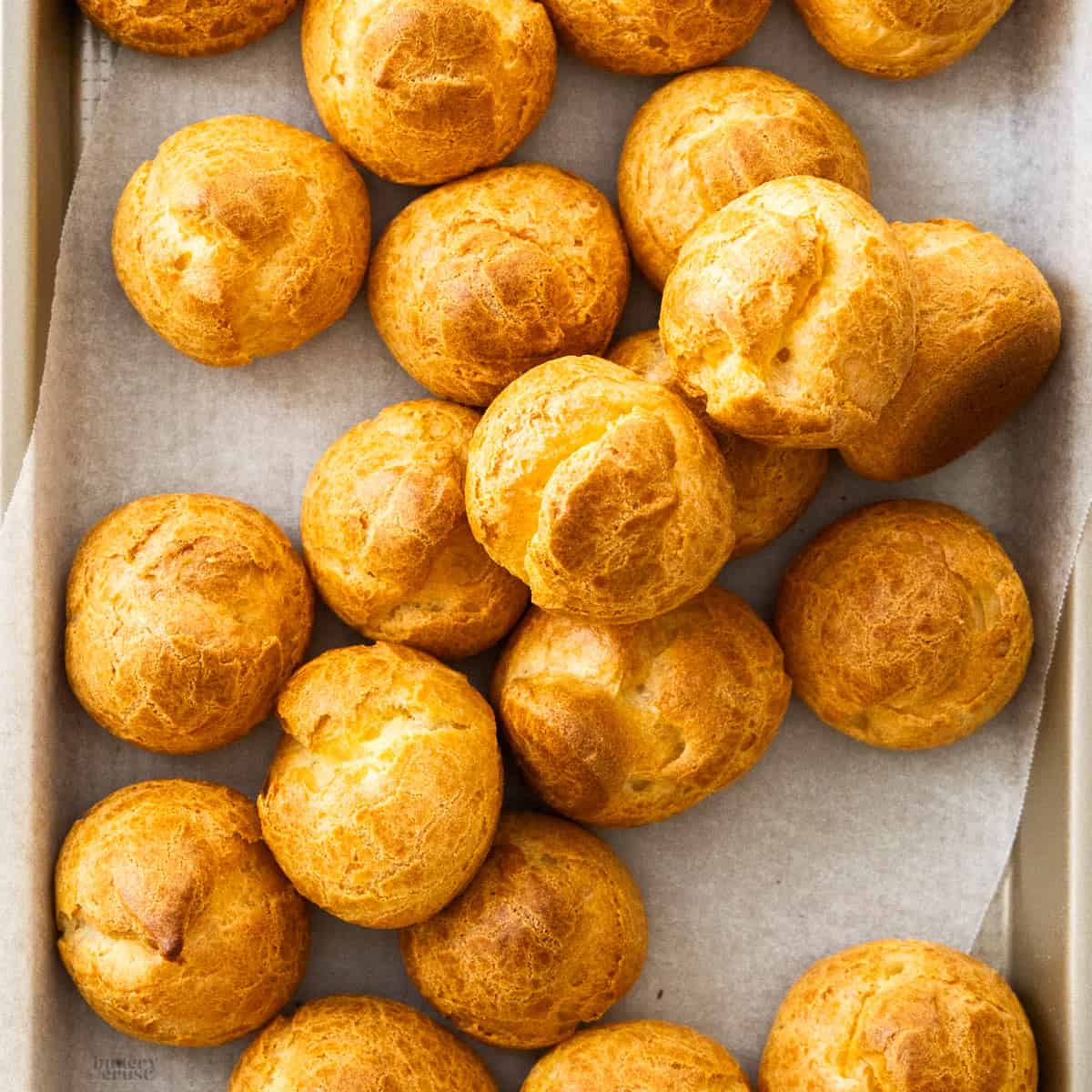
How to make Choux Pastry
Find out how to make choux pastry - that delicate, crisp French pastry that's so versatile. It's probably easier than you think too!
Print
Pin
Servings: 32 serves
Calories: 53kcal
Equipment
- Medium heavy-based saucepan
- Wooden spoon / rubber spatula
- Piping bag
For best results, weigh ingredients with a kitchen scale.
Ingredients
- ½ cup water (125ml)
- ½ cup whole milk (125ml)
- 115 g unsalted butter (4oz / 1 stick)
- 2 teaspoons white granulated sugar
- ¼ teaspoon salt
- 130 g plain flour (all purpose flour) (1 cup, spooned and levelled/~4 ½oz)
- 200-230 g eggs (7-8oz / 4-5 large eggs, see notes)
Instructions
- Preheat oven to 190C / 375F. Line 2 large baking sheets with silpats (recommended) or baking paper/parchment paper.
- Combine the water, milk, butter, sugar and salt in saucepan and heat over medium stirring to melt the butter, then allow it to start to bubble.
- Once you see the first bubbles, turn the heat off. Add the flour and stir in with the spatula until fully combined.
- Place the pan over low heat and cook for 2 minutes, moving constantly. Fold it over itself then press it out across the pan and repeat for 2 minutes.
- By hand: Press the dough out flat over the base of the pan and leave it to cool for 5-10 minutes until it’s no longer hot (warm is fine).By stand mixer: Transfer the dough to a stand mixer with a paddle attachment and beat on low for 2 minutes.
- Lightly beat 4 eggs together in a jug (or shake them up in a jam jar).
- Add a quarter of the eggs to the panade/dough with one of these 3 methods;- In the stand mixer with paddle attachment and mix on low.- Beat by hand, directly in the saucepan with a silicone spatula or wooden spoon.- Use a handheld mixer on low.
- Continue by adding another quarter of the eggs, beating until fully incorporated. Repeat with the third quarter of eggs.
- With the last quarter of the eggs, add them just a little at a time until you have a dough that is smooth and shiny. It should reluctantly fall from the spoon leaving a “V” shape hanging from it.
- Once the dough is the right consistency, transfer it to a piping bag and pipe as desired. This recipe will make around 32 regular choux buns or 14-16 eclairs. They will need to bake, depending on size, anywhere from 30-45 minutes. When your choux pastries come out of the oven, as soon as you can handle them, poke a couple of holes in the base with a skewer or toothpick.
- Please take a moment to rate this recipe. I really appreciate it and it helps me create more recipes.
Notes
- How many eggs? With choux pastry, the texture is best judged by eye, not by quantity of eggs. Add the eggs until the dough is at the right texture. For me it's between 3 ½ and 4 large eggs but the amount you require will be determined by many variables - egg size, amount of moisture cooked out of panade, protein content of flour and even humidity in the air.
- Store baked choux pastries in an airtight container in a cool place, like the pantry for 2 days or fridge for 3-4 days. They can also be frozen for up to 3 months in an airtight container.
- They are only crispy straight from the oven and will begin to gradually soften. You can re-crisp them before filling by placing them in an oven preheated to 180C/350F for 7-10 minutes.
- Don't fill until they're cool.
- Fillings will soften the choux pastry so they're best filled as close to serving as possible.

Love the recipe?Add The Buttery Crust to your Google Preferred Sources!
Nutrition
Calories: 53kcal | Carbohydrates: 4g | Protein: 1g | Fat: 4g | Saturated Fat: 2g | Polyunsaturated Fat: 0.2g | Monounsaturated Fat: 1g | Trans Fat: 0.1g | Cholesterol: 31mg | Sodium: 52mg | Potassium: 20mg | Fiber: 0.1g | Sugar: 0.5g | Vitamin A: 130IU | Calcium: 10mg | Iron: 0.3mg
